

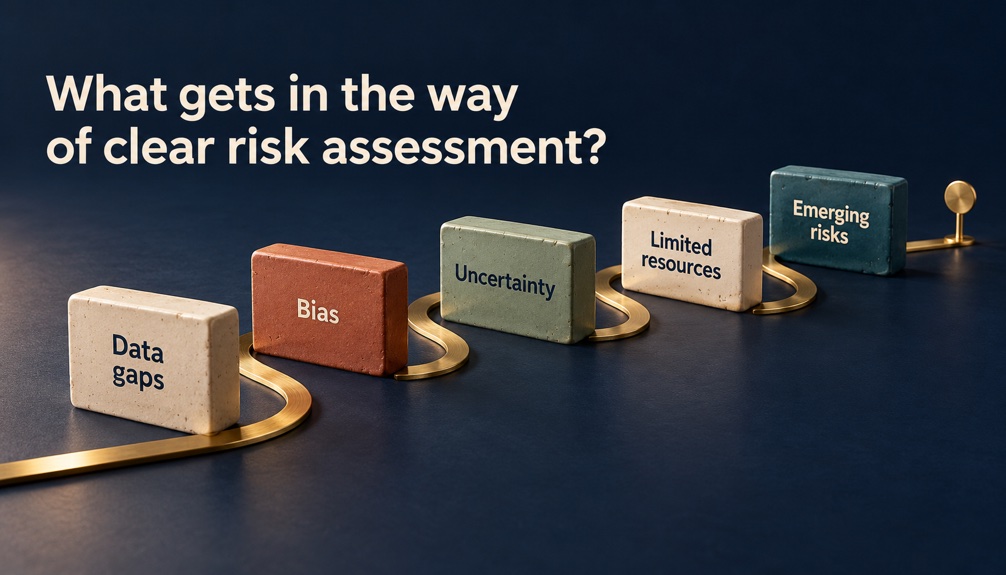
The key challenges in risk assessment are incomplete information, subjective judgement, uncertainty, limited resources and risks that change over time. Hazard identification can also miss less obvious problems when teams rely on familiar checklists or overlook the experience of people doing the work.
A practical response is to define the scope, involve relevant people, document assumptions and review whether controls are working. These steps improve the basis for decisions; they do not remove uncertainty.
Lack of data and information

A risk rating is difficult to defend when incident records are incomplete, information is outdated or departments collect data differently. An absence of reports may reflect a reporting gap rather than an absence of risk.
Start by asking what evidence you have, how current it is and what is missing. Compare operational records with staff observations, complaints and previous reviews. Record important gaps alongside the assessment.
Practical response: give someone responsibility for checking the missing information and agree when the assessment should be revisited. Use a reasoned range or clearly qualified judgement where a precise estimate cannot be supported.
Subjective biases and assumptions
People interpret risks through their own experience. A recent incident may dominate discussion, while a familiar problem may be treated as acceptable simply because it has not yet caused serious harm.
Different interpretations of “likely” or “major” can also produce inconsistent ratings across teams. Seniority and confidence may carry more weight than evidence in a group discussion.
Practical response: agree rating definitions and an assessment period before scoring. Ask participants for their initial views independently, then discuss the evidence behind differences. Record assumptions and invite someone to challenge them.
A matrix can organise the discussion, but it cannot make subjective judgements objective simply by attaching numbers.
Uncertainty and complexity

Risks often depend on each other. A supplier failure could affect service delivery, staffing and finances at the same time. Assessing each department in isolation can miss those connections.
Uncertainty grows when activities are new, evidence is sparse or the external environment changes. A detailed model can still mislead if its assumptions do not reflect the situation.
Practical response: map the main dependencies and test a few plausible scenarios. Explain what could change the conclusion. Choose assessment methods that suit the decision and evidence, rather than adding complexity for its own sake.
Resource constraints
Time, budget and access to specialist knowledge can limit how deeply a team assesses its risks. A long register can make the problem worse if it mixes minor issues with concerns that need a management decision.
Practical response: define the scope and prioritise the decisions that need attention. Give risks and actions named owners, schedule follow-up and identify where specialist input is needed. Use a consistent record so staff do not have to reconstruct the assessment at every review.
Software can help organise records and reports, but it does not replace the knowledge required to assess an unfamiliar activity.
Evolving and emerging risks

An assessment can become outdated when staffing, suppliers, technology or working arrangements change. Copying last year's ratings forward may conceal new dependencies or controls that no longer operate as intended.
Practical response: set review dates and agree triggers for an earlier review, such as an incident, a significant change or evidence that a control is failing. Ask risk owners what has changed, not just whether the existing score should stay the same.
Check whether outstanding actions have reduced exposure. Completing an action and demonstrating that a control works are related but different tasks.
Common challenges in hazard identification
Workplace hazards are things that can cause harm. They can be missed when a review covers only normal operations, relies entirely on paperwork or excludes the people exposed to them.
Pay particular attention to:
- Non-routine work, including maintenance, cleaning and temporary arrangements.
- Less visible concerns, such as manual handling or work-related stress.
- Contractors, visitors and people whose circumstances affect their exposure.
- Handover points where responsibility moves between teams.
- Near misses and recurring workarounds that are not captured in formal records.
HSE recommends looking at how work is done, reviewing previous records and involving workers. Use a checklist as a prompt, then check it against the actual activity and people involved.
For wider business and project risks, our guide to risk identification techniques covers workshops, interviews and other ways to surface missing information.
Turning an assessment into action
Even a well-reasoned assessment can fail to influence decisions if actions have no owner or controls are never reviewed. Keep the response visible alongside the rating: what needs to happen, who is responsible and how progress will be checked.
RiskMate supports shared risk records, assigned responsibilities and reports on overdue actions. These tools help teams follow up their decisions and prepare information for management review.
Frequently asked questions
What is the biggest challenge in risk assessment?
It depends on the activity. Incomplete information, inconsistent judgement and failure to follow through are common obstacles. Start by identifying which gap is preventing a decision, rather than assuming every assessment needs more data or a more complex model.
How can teams assess risks with limited data?
Use the best relevant evidence available, involve people with direct knowledge and state where the judgement is uncertain. Record what further information would change the decision and who will obtain it.
How do you reduce bias in a risk workshop?
Use clear criteria, invite different perspectives and ask for individual views before group discussion. Examine the reasons behind disagreement and keep a record of the assumptions used.
How often should a risk assessment be reviewed?
Set a review frequency appropriate to the risk and activity, and revisit it when circumstances or evidence change. HSE's workplace guidance also highlights reviewing controls after problems, accidents or near misses. Review should examine the controls and actions, not just the date on the document.