

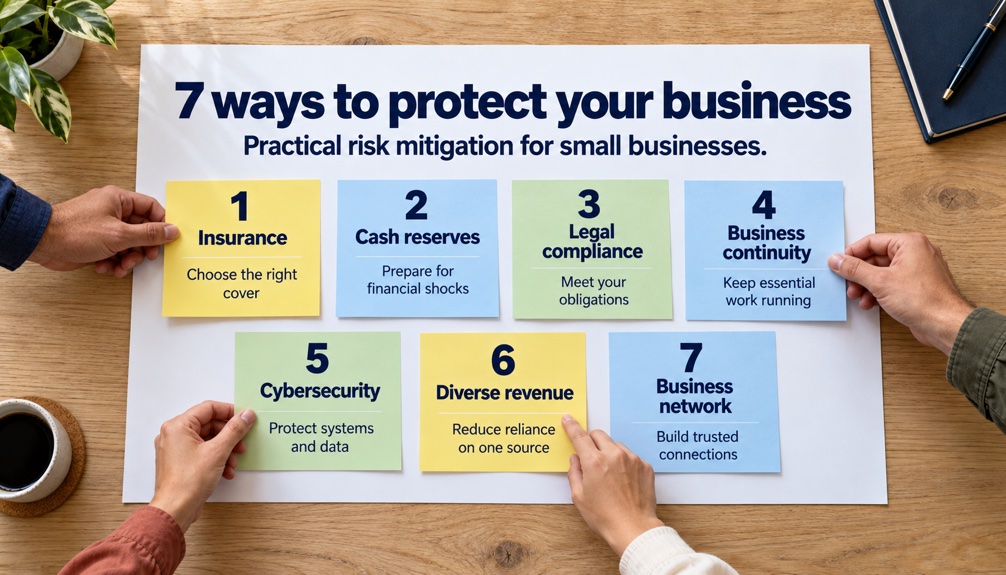
Small business risk mitigation means taking practical steps to reduce the likelihood or consequences of events that could disrupt the business. The right measures depend on your exposure: late payments, unavailable systems, loss of a key supplier or work that cannot continue when someone is absent.
This guide covers seven measures you can adapt to the risks you have identified. If you are setting up a register for the first time, start with our practical risk management tips for small businesses.
1. Review insurance against your actual exposure

Insurance can help share the financial consequences of some events. It does not remove the underlying risk or guarantee that every loss will be covered.
Review the activities, assets and liabilities your business depends on. Discuss appropriate cover with your insurer or broker, and compare limits, exclusions, conditions and excesses rather than price alone.
The UK government's business insurance guidance explains different types of cover and what to check in policy documents.
Example: a business dependent on a workshop reviews whether its arrangements address damage to equipment and interruption to trading, including the conditions attached to the cover.
Follow-up: assign responsibility for policy reviews and tell the insurer about relevant changes to the business. Keep the incident information needed to support a claim.
2. Plan for cash-flow disruption
A profitable business can still struggle if payments arrive after bills fall due. Build a cash-flow forecast around expected payment dates and test what would happen if a major customer paid late or sales fell.
The Insolvency Service's cash-flow guidance highlights payment delays and the need to plan for unexpected as well as regular expenses.
Example: the owner checks how a delayed customer payment would affect the next payroll and supplier payments. This exposes the point at which action would be needed.
Follow-up: give someone responsibility for monitoring overdue invoices and updating the forecast. Agree escalation triggers and discuss suitable contingency arrangements with the business's accountant or finance adviser.
3. Make compliance and contractual responsibilities visible

Unclear responsibilities can leave important renewals, checks and contract commitments unattended. Keep a record of the requirements relevant to your business, who owns them and when they need attention.
For contracts, make sure the responsible person understands deliverables, payment arrangements, dependencies and renewal dates. Use appropriate professional advice where the terms or obligations need specialist interpretation.
Example: a service provider assigns an owner to check that a customer contract's reporting requirements are being met before each review meeting.
Follow-up: revisit the record when the business changes its activities, people or agreements. A checklist supports administration; it does not establish that every legal obligation has been met.
4. Test how essential work would continue
Business continuity planning starts with the activities you need to restore or maintain during disruption. Identify the people, premises, systems and suppliers those activities rely on, then plan a workable alternative.
The government's Expecting the Unexpected guide provides a reference for developing business continuity arrangements.
Example: a business unable to use its premises agrees how customers will be contacted, where essential staff can work and how they will access the records they need.
Follow-up: walk through the plan with the people expected to use it. Check contact details, access arrangements and dependencies, then record and resolve the gaps. A rehearsal can reveal problems that reading the document alone misses.
5. Protect accounts, devices and business data

Cyber security measures should address the systems and information your business relies on. Begin with important accounts, supported software, backups and a clear route for staff to report suspicious activity.
The NCSC's guide for small organisations covers securing email and accounts, protecting devices, backing up data and spotting attacks. The ICO's practical security guidance also recommends checking backups and using strong passwords and multi-factor authentication.
Example: a business enables multi-factor authentication on its email accounts and tests whether essential files can be recovered from backup.
Follow-up: assign responsibility for updates, access reviews and backup checks. Remove access when it is no longer needed and make sure staff know how to report a suspected compromise promptly.
6. Reduce dependence on one source of income
Reliance on a single customer, contract or route to market can leave a business exposed when that relationship changes. Identify where revenue is concentrated and assess the effect of losing or delaying it.
Diversification can help, but entering a new market or adding a service also introduces costs and unfamiliar risks. Assess those trade-offs before committing resources.
Example: an owner whose largest contract is approaching renewal considers what a delayed renewal would mean for staffing and delivery commitments, then develops a proportionate response.
Follow-up: review concentration at agreed intervals and before taking on commitments that assume the income will continue. Monitor whether any new activity is reducing exposure or creating a different dependency.
7. Build dependable supplier and support relationships

A useful business network provides access to alternatives and expertise when something goes wrong. Focus on the relationships your operations actually depend on, such as suppliers, technical support and specialist advisers.
Keep key contacts current and understand how quickly alternatives could become available. An untested backup supplier may not be able to provide the same capacity, quality or turnaround time.
Example: a small manufacturer identifies an alternative for a critical component and checks its specifications and lead time before an interruption occurs.
Follow-up: name an owner for important supplier relationships and review warning signs such as repeated delays. Include dependency risks in your risk register rather than relying on personal knowledge alone.
Turn the measures into accountable actions
Choose measures that address your most significant risks, rather than trying to implement every suggestion at once. Record what each action is intended to change, its owner, due date and how effectiveness will be checked.
For example, “improve continuity” is difficult to follow up. “Test access to customer records from the fallback location before the next review” is a concrete action.
RiskMate supports risk records, assigned responsibilities and reports on overdue actions. See how its risk management software for businesses can help keep this work visible to managers.
Common questions from small business owners
What is the difference between risk management and mitigation?
Risk management is the wider cycle of identifying, assessing, responding to and reviewing risks. Mitigation focuses on measures that reduce likelihood or consequences. Insurance and contingency arrangements may address consequences while other controls address causes.
Which strategy should a small business prioritise?
Start with the exposures that could most seriously affect people, essential services or the business's ability to operate. Consider existing controls, the evidence available and the resources needed for an effective response. Escalate specialist questions to someone with suitable expertise.
How do you know whether a measure is working?
Decide what evidence would demonstrate its effect and review it. That might mean a successful recovery test, fewer repeated errors or confirmation that a dependency has changed. Completing an action is useful, but checking its effect is what informs the next decision.