

Risk identification and assessment are important because they help an organisation recognise what could affect its objectives, decide which risks need attention and take informed action. Identification describes what could happen; assessment considers likelihood, consequences and existing controls.
The benefit comes from using the findings. A completed assessment has little value if responsibilities are unclear, controls are not implemented or the information is never reviewed.
Understand risks before they become problems
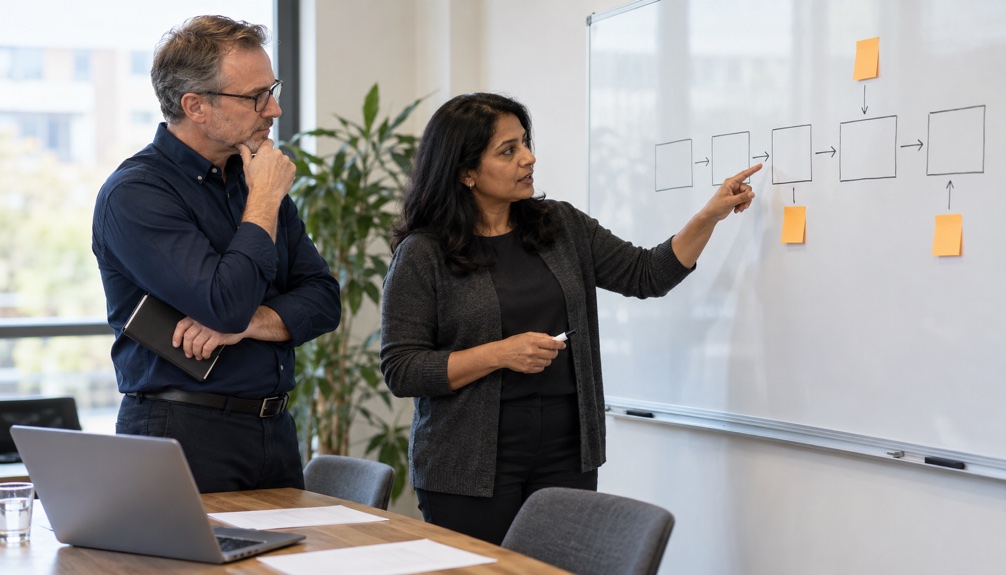
Day-to-day familiarity can make weaknesses easy to overlook. A structured conversation brings assumptions into the open and invites people from different roles to share what they know.
For example, a team may rely on one employee to maintain a service. Identifying that dependency gives managers a chance to consider cover and training before an absence interrupts delivery.
Use risk identification methods such as interviews, incident reviews and workshops to build a clearer picture. No method can reveal every possible event, so keep asking what has changed.
Decide what needs attention first
Organisations have limited time and resources. Assessing risks helps managers compare concerns using agreed criteria and explain why some need earlier action.
Consider the consequences as well as likelihood. A frequent minor problem and a rare severe event may need different responses, even when their scores appear similar. Include effects on people, services and objectives rather than reducing every decision to cost.
A shared basis for assessment makes discussion more consistent. It also exposes disagreements that need evidence or further investigation.
Choose controls that address the causes

An assessment should help explain why a risk could occur and whether existing controls are adequate. That makes it easier to choose an action that addresses the cause.
For example, repeated errors during a handover may call for a clearer process and checks, rather than a general reminder to be careful. Record what the control is meant to achieve and how you will check that it works.
For workplace health and safety, HSE's risk assessment guidance connects identifying hazards with assessing, controlling, recording and reviewing risks. The practical action matters as much as the record.
Make responsibility and follow-up clear
A useful assessment identifies who owns the risk, what further action is needed and when it should be completed. This gives teams a way to follow up unresolved issues and raise matters that need a management decision.
Distinguish responsibility for monitoring a risk from responsibility for completing an action. The same person may do both, but that should be explicit.
An online risk register can keep these records together and support reporting. It still needs staff to maintain the information and managers to act on it.
Support decisions and explain them to others
Boards, managers and other stakeholders need to understand significant risks and the reasons behind proposed responses. Assessments provide a record of the evidence considered, assumptions made and actions agreed.
This can support decisions about projects, services, suppliers and resources. It also gives future reviewers a basis for asking whether the original judgement remains appropriate.
Recording a rating alone is rarely enough. Explain the possible event, its consequences, the controls and any important gaps in knowledge.
Learn and adapt as circumstances change

Risk assessments capture a view at a particular time. New suppliers, staffing changes, incidents or changes in service demand can make that view outdated.
Build review into your risk management process. Check whether actions were completed and controls had the intended effect. Where an incident occurs, use what you learn to improve the assessment and response.
Review is also an opportunity to retire assumptions that are no longer useful. Carrying an unchanged entry forward indefinitely can obscure the risks that need current attention.
What risk assessment cannot do
Assessment cannot guarantee that an incident will be prevented or predict every consequence. Ratings depend on the information, definitions and judgement used. Numerical models also depend on their assumptions.
Make these limits visible. If evidence is incomplete, record the gap and agree what to do about it. If different teams disagree, explore their reasons instead of forcing agreement on a score.
Our guide to key challenges in risk assessment offers practical responses to uncertainty, bias and limited resources.
Common questions about the importance of assessment
Why carry out a risk assessment before starting a project?
It gives the team an opportunity to examine dependencies, challenge assumptions and plan responses while changes are still possible. Review it during delivery, because an initial assessment will not capture every later development.
Why is identification important before assessment?
You need a clear description of the risk before judging it. A vague entry such as “suppliers” gives little basis for choosing controls. Describing the cause, possible event and consequences makes the next decision more useful.
Does every risk need detailed numerical analysis?
No. Match the analysis to the decision and available evidence. Our guide to risk assessment methods explains how qualitative assessment, quantitative analysis and supporting approaches serve different purposes.